
Road cargo from Dubai to Jordan is one of the most practical ways to move goods between the UAE and the Levant. A truck leaves Dubai, crosses Saudi Arabia, and delivers directly to a door in Amman or another Jordanian city, without the goods changing hands between ships, planes and local couriers. For many businesses, that single, unbroken journey is the main attraction: the cargo is loaded once, sealed, tracked along the road, and unloaded at its destination. In this guide, we explain what road cargo from Dubai to Jordan involves, how long it takes, what it costs, which documents you need, and how door to door delivery works in practice.
If you are sending cargo to Jordan from Dubai, road freight is often the best balance of speed and cost. It is faster than sea freight through Aqaba, and for most commercial loads it is considerably cheaper than air freight. It also suits the kinds of shipments Jordan receives every week from the UAE: shop stock and retail goods, building materials, machinery and spare parts, household furniture, and personal effects for people relocating to Amman. Because the truck travels overland, there is no need to wait for a sailing schedule, and collection and delivery times can be planned around your own working week.
What Is Road Cargo from Dubai to Jordan?
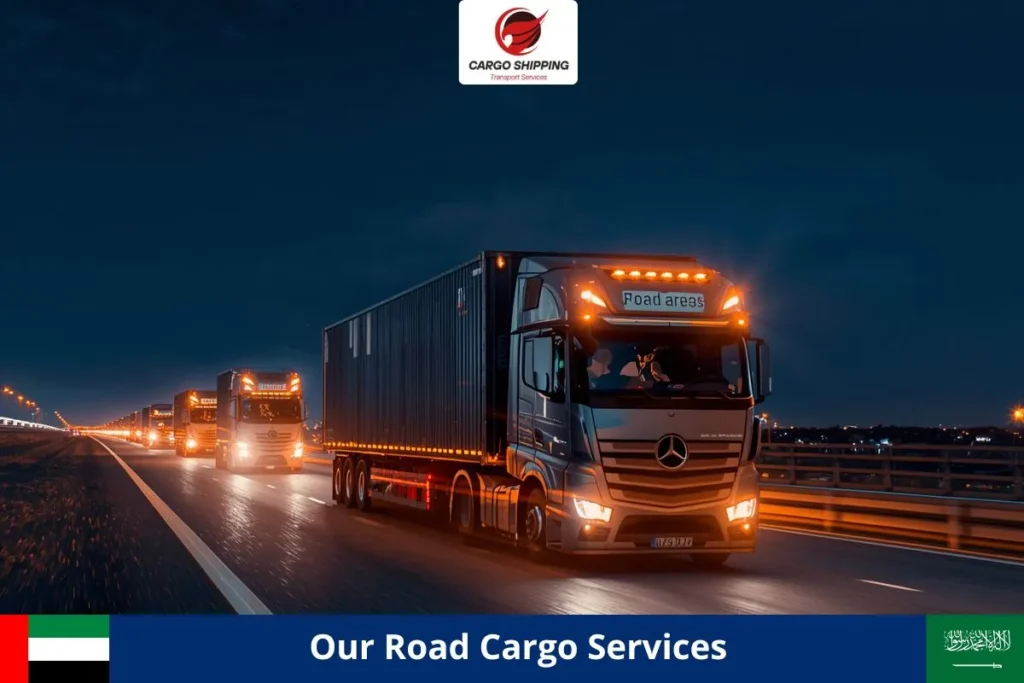
Road cargo is freight carried by truck for the whole overland journey, from collection in Dubai to delivery in Jordan. The goods are packed, loaded onto a truck or trailer at your warehouse, home or our Dubai facility, and the same vehicle — or a matched trailer under the same shipment — carries them through the UAE–Saudi border, across Saudi Arabia, and into Jordan. At the Jordanian border, the shipment clears customs, and the truck continues to its final delivery address. There is no transhipment at a port and no need to repack the goods part way through the journey.
The service works for a wide range of loads. A full truckload suits a business moving a large consignment in one go, while part-load, or groupage, suits smaller shipments that share space on a truck with other cargo heading the same way. Temperature-controlled trailers are available for chilled and frozen goods, and for food, pharmaceuticals and other temperature-sensitive products. Flatbed and curtain-side trailers suit machinery, building materials and other awkward loads, while box trucks suit palletised goods, cartons and household items that need protection from dust and weather.
Road freight also gives you a clear chain of responsibility. One carrier manages the booking, the truck, the border paperwork and the delivery, so if a question comes up at a border or at delivery, there is one team to call. That matters on a route with two border crossings, because a small paperwork problem at the Saudi border can hold up a delivery in Amman if it is not spotted early. A good road cargo provider checks documents before the truck leaves Dubai, rather than discovering a problem hundreds of kilometres down the road.
How Long Does Road Freight to Jordan Take?
Road freight to Jordan transit time is typically 3 to 5 days door to door from Dubai to Amman. The driving itself usually takes 2 to 3 days, and the rest of the time is taken up by loading, border formalities at the UAE–Saudi crossing and the Saudi–Jordan crossing, and final delivery in Jordan. A straightforward commercial shipment with complete paperwork can reach the faster end of that range, while a shipment that needs inspection, extra documentation or a delivery to a more remote address can take a little longer.
Transit time is not only about distance. Border queues, the time of day the truck arrives at a crossing, weekends, and public holidays in Saudi Arabia and Jordan can all add hours, and occasionally a day, to the journey. That is why a realistic delivery promise matters more than an optimistic one. When we quote a transit time, we allow for normal border processing, and we keep you updated if a crossing is slower than usual. If your goods are urgent, tell us at the booking stage: an earlier departure, a dedicated truck, or a combination of road and air for part of the load can sometimes save a day.
- Dubai to Amman by road: typically 3 to 5 days door to door.
- Driving time alone: usually 2 to 3 days, depending on the route and stops.
- Dubai to Aqaba by sea: typically 7 to 10 days port to port, before road delivery onward.
- Urgent small parcels: air freight can be faster, but costs more per kilogram.
Which Route Do Trucks Take from Dubai to Amman?
The road route from Dubai to Amman runs north-west through Saudi Arabia. Trucks leave the UAE at Al Ghuwaifat, on the Abu Dhabi border, and enter Saudi Arabia at Al Batha. From there, the route runs north through Saudi Arabia, passing the Riyadh area and continuing towards Tabuk, before reaching the Jordanian border at the Al Omari, or Haditha, crossing. After Jordanian customs clearance, the truck follows Highway 15 south to Amman, the capital and the main delivery hub for the country.
Knowing the route helps you understand where delays can happen and why paperwork matters at each stage. The UAE–Saudi crossing is where the export and transit documents are first checked, and the Saudi–Jordan crossing is where Jordanian import clearance takes place. Our team prepares the transit and import paperwork in advance, so the driver is not left to explain a commercial shipment at a border post. The same route is used for road cargo to Saudi Arabia, with trucks continuing north for Jordan, and it is a well-established corridor for road cargo to Doha and other Gulf destinations that share the first leg of the journey.
How Does Door to Door Cargo to Jordan Work?
Door to door cargo to Jordan means we collect your goods in Dubai and deliver them to the address you give us in Jordan, with customs and border formalities handled along the way. You do not need to drop goods at a port, collect them from a terminal, or arrange a separate local courier in Amman. The steps below are the usual journey for a commercial shipment, and the same outline applies, with a few extra documents, to personal effects and household goods.
Step 1: Get a quote and book your shipment?
Share the type of goods, their weight and dimensions, the collection address in Dubai, and the delivery address in Jordan. Photographs of unusual or oversized items help us choose the right truck. We confirm the price, the collection day, and the expected delivery window, and we tell you which documents we need from you before collection.
Step 2: How are goods collected and packed?
We collect from your home, warehouse, office or supplier in Dubai, or you can deliver to our facility. Goods are checked against the packing list, weighed and measured, and packed or repacked for a long road journey. Fragile items are protected, pallets are wrapped and strapped, and the load is secured inside the truck so it does not shift on the long drive north. Good packing matters: most road damage comes from poor packing, not from the road itself.
Step 3: How is customs clearance handled?
Before the truck leaves, our team prepares the export documents and the Saudi transit paperwork, and checks the Jordanian import documents. At Al Ghuwaifat and Al Batha, the shipment is presented for export and transit clearance. At the Jordanian border, it is presented for import clearance, and any duties and taxes are paid as agreed. Our customs clearance in Dubai team can explain which charges apply to your goods, because duties depend on the type of goods, their value, and whether an import licence is needed in Jordan.
Step 4: How does delivery in Jordan work?
After clearance, the truck continues to its destination, usually Amman first, then onward to other cities if needed. The driver or our local partner contacts the receiver before delivery to confirm the time and access for the truck. On arrival, the goods are checked against the delivery note, signed for, and unloaded. If the delivery address is in a narrow street or a building without truck access, we agree a practical unloading point with the receiver in advance.
Should You Choose Full Truckload or Part Load?
Full truckload, or FTL, means you hire the whole truck for your shipment alone. It is usually the best choice for large commercial loads, for goods that fill most of a truck, for urgent shipments that cannot wait for other cargo, and for sensitive loads that should not share space with other goods. The truck leaves when your goods are ready, and the price is quoted per trip, not per kilogram, which makes budgeting straightforward for regular shippers.
Part load, also called LTL or groupage, means your goods share a truck with other shipments heading to Jordan. You pay only for the space and weight you use, which makes it the sensible choice for a few pallets, a small shop order, or a modest household move. The trade-off is timing: the truck may wait until it has enough compatible cargo, and there may be more than one delivery stop in Jordan. For most small and medium shipments, that trade-off is worth the saving, and it is also a more efficient use of a truck.
Temperature-controlled transport is available for both options. A refrigerated truck keeps chilled goods cool and frozen goods frozen for the whole journey, including border waits, which is important in the summer heat of the Gulf and the Saudi desert. If you are sending food, medicine or flowers, tell us the temperature your goods need, and we will match the vehicle and check the temperature log at delivery.
What About Sea Freight to Aqaba as an Alternative?
Sea freight is a useful alternative for large, heavy or non-urgent cargo. A container can sail from Jebel Ali to Aqaba port in typically 7 to 10 days port to port, and the goods are then cleared and delivered by road to Amman or another city. For very heavy machinery, bulk goods or a full container that does not need to arrive quickly, sea freight through Aqaba can cost less than a dedicated road truck, especially if the goods can wait.

The choice between road and sea usually comes down to time, cost and the size of the load. Road wins on speed and on door to door simplicity, because the same truck that collects the goods delivers them. Sea wins on cost for large, heavy loads that are not urgent. Air freight wins when a small, valuable or urgent shipment must arrive in a few days, but the cost per kilogram is far higher. Many regular shippers use road for their normal stock and sea for their heavier, slower-moving goods, and we are happy to quote both options so you can compare them side by side.
How Much Does Road Cargo to Jordan Cost?
Road cargo prices vary, and any figure quoted without knowing your shipment is only a guide. A full truckload is priced per trip, and the price depends on the truck type, the route, and the time of year. A part load is priced by the space and weight your goods use, so a few light cartons cost far less than several heavy pallets. Fuel prices, border fees, and the cost of customs clearance and delivery in Jordan also affect the final price, as does whether the goods need a refrigerated truck or special handling.
Because of those variables, we do not publish a fixed price for road cargo to Jordan. Instead, we give an exact quote for your shipment once we know the weight, volume, collection and delivery addresses, and the type of goods. That quote includes collection in Dubai, transport, border handling, and delivery in Jordan, with duties and taxes shown separately where they apply. If you are comparing quotes, check that each one includes the same services: a cheaper quote that leaves out customs clearance or final delivery can end up costing more.
There are a few ways to keep the cost down without cutting corners. Packing goods tightly on standard pallets reduces the space they take up. Booking a part load, rather than a dedicated truck, shares the cost of the journey. Sending a regular weekly or monthly load can earn a better rate than a one-off shipment. And sending complete, correct documents the first time avoids storage and re-handling charges at borders. Small savings on packing and paperwork often add up to a noticeable difference over a year of regular shipments.
What Documents Do You Need to Send Cargo to Jordan?
Good paperwork is what keeps a road shipment moving. For a commercial shipment, you usually need a commercial invoice showing the goods, their value and the buyer and seller; a packing list showing the weight, dimensions and contents of each package; a certificate of origin; and a bill of lading or CMR, the transport document that travels with the truck. Some goods also need a Jordanian import licence, so check this with your buyer in Jordan before the truck leaves Dubai, not after it reaches the border.
For personal effects and household goods, a passport or ID is usually needed, along with a packing list and a simple description of the items. Used personal effects are often treated differently from new commercial goods, so tell us what you are sending and we will confirm the right documents. Whatever the shipment, make sure the names, addresses and goods descriptions match on every document. A small difference — a different spelling of a company name, or a weight that does not match the packing list — is one of the commonest causes of border delays.
Which Cities in Jordan Can We Deliver To?
Most road deliveries in Jordan go to Amman, the capital, where most businesses, warehouses and homes are based. We also deliver to Aqaba, the port city on the Red Sea, which is a useful destination for goods arriving by sea and for businesses in the south. Zarqa, the industrial city north-east of Amman, is a regular delivery point for factories and workshops, and Irbid, in the north, is served for businesses and households in that region. Deliveries to smaller towns can usually be arranged, with the delivery time depending on the distance from Amman and the size of the truck needed.
If your delivery address is outside the main cities, share the full address and any access notes when you book. A large truck may not be able to reach a narrow street, so we may deliver to a nearby point and transfer the goods to a smaller vehicle. Planning this in advance avoids a failed delivery and an extra day on the road. The same door to door approach is used for our other Gulf road routes, including road cargo to Kuwait and road cargo to Bahrain, so if you ship to more than one country in the region, the process will feel familiar.
What Can You Send by Road to Jordan?
Most general cargo can travel by road: retail and wholesale stock, clothing and textiles, electronics, building materials, machinery and spare parts, furniture, and food that travels in a refrigerated truck. Personal effects, including household goods for a move to Jordan, are also common, as are exhibition goods, office equipment and small commercial consignments. If you are unsure whether your goods can travel by road, send us a list and we will confirm.
Some goods need extra care or cannot travel by road at all. Hazardous goods need the right classification, packaging and vehicle, and some chemicals and batteries are restricted. Perishable goods need a refrigerated truck and a realistic transit time. If you are sending goods to Jordan for the first time, or if your goods fall into one of these categories, tell us early so we can plan the right vehicle and paperwork. For onward shipments from Jordan to other countries in the region, our cargo to Syria service is also available from Dubai.
Frequently Asked Questions About Road Cargo from Dubai to Jordan?
How long does road cargo from Dubai to Jordan take?
Typically 3 to 5 days door to door to Amman, with 2 to 3 days of driving through Saudi Arabia. Border processing, loading and final delivery make up the rest of the time, so a shipment with complete paperwork is usually at the faster end of the range.
How much does road cargo to Jordan cost?
It depends on the weight, volume, truck type and delivery address. A full truckload is priced per trip, and a part load is priced by the space and weight used. Fuel, border fees and customs charges also affect the price, so we give an exact quote for each shipment rather than a fixed rate.
Can you deliver door to door in Amman?
Yes. Door to door delivery to Amman is the standard service. We collect in Dubai, handle the border and customs formalities, and deliver to the address you give us in Amman, Zarqa, Irbid or Aqaba, subject to truck access at the delivery point.
What documents do I need for cargo to Jordan?
For commercial goods, you usually need a commercial invoice, a packing list, a certificate of origin, and a bill of lading or CMR, plus a Jordanian import licence where required. For personal effects, a passport or ID and a packing list are usually needed. We check your documents before the truck leaves Dubai.
Is sea freight to Aqaba better than road freight?
It depends on your priorities. Sea freight to Aqaba takes typically 7 to 10 days port to port and can cost less for large, heavy, non-urgent loads. Road freight is faster, typically 3 to 5 days door to door, and simpler, because the same truck collects and delivers your goods. We can quote both options so you can compare.
Road cargo from Dubai to Jordan works best when it is planned well: complete documents, sensible packing, and a realistic delivery window. If you would like a quote, share the details of your shipment — the goods, the weight and size, and the collection and delivery addresses — and we will confirm the price, the truck, and the expected delivery day. Whether it is a single pallet or a full truckload, door to door road freight keeps your goods moving, with one team responsible from Dubai to Amman.

